Silhouettes in Underwater Photography
Creating silhouettes is backlighting taken to an extreme. Objects with strong shapes or easily recognizable shapes can make excellent silhouettes. Combine with a strong foreground or background for a great shot. All detail in the front of the subject is lost. Silhouettes often work because of their simplicity. For example, a fish close up with the sun directly behind it.
Silhouettes are often enhanced with a sunburst in the photo. Remember to use a fast shutter speed (1/150th or higher) to freeze the sunrays.
Let's summarize how to create good silhouettes:
Pick a shape that has strong form and is easily recognizable, such as a diver, turtle, shark, manta, etc.
Make sure there is strong contrast between the object and the background. Obviously having the sun or bright water behind the subject is the best way
Use manual exposure mode or meter off the brighter area of the background
The subject should be isolated away from the reef, or in blue water
Turn off your strobes
The outline of the silhouette should be very crisp. A high shutter speed wil help in this.
Bracket your exposures if possible
A silhouette should be black or near black
Underexpose the blue water a little bit to make sure your silhouetted subject is nice and black!

Silhouettes should have strong shapes. Diver on wreck, Anilao, Phillipines.

Cormorant swimming at the oil rigs. Photo by Todd Winner. F5, 1/60th, ISO 100, 17mm

These red-toothed triggerfish have a distinct shape, making them good candidates for silhouettes.

Schooling fish in Bali, photo by Scott Gietler

Diver and a sunburst. photo by Diana Vicei. Nice example of silhouette and a sunburst.

One of my favorite silhouette techniques is to have the sun directly behind the subject, capturing the rays of the sun. Photo by Rand McMeins. Bracket exposures for best results.
Hot tip for creating silhouettes
When shooting with strobes, take two photos in rapid succession. Assuming your strobe does a full dump on the first shot, there's a good chance you'll get a silhouette on the second shot, without having to turn your strobes off. I use this technique all the time with my YS-D1 strobes, while in continuous shooting mode.

This photo of bumphead parrotfish in Bali was taken when I fired 2 shots in quick succession. My strobes did not have time to recycle for the second shot. Instant silhouette! F9, 1/320th, ISO 320

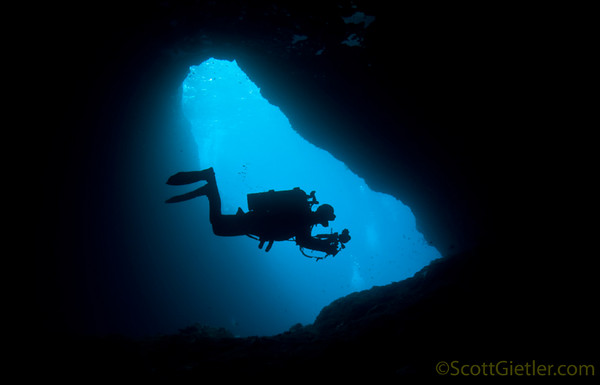
The famous "Kalani in a cave" photo, taken in Bali. Strobes were off, Kalani swam slowly, I made sure his outline was completely surrounded by water, and the blue water behind him was underexposed, ensuring a nice black silhouette. F6.3, 1/80th, ISO 200
Further Reading
RECOMMENDED ARTICLES


SUPPORT THE UNDERWATER PHOTOGRAPHY GUIDE:
The Best Service & Prices on u/w Photo Gear
 Visit Bluewater Photo & Video for all your underwater photography and video gear. Click, or call the team at (310) 633-5052 for expert advice!
The Best Pricing, Service & Expert Advice to Book your Dive Trips
 Bluewater Travel is your full-service scuba travel agency. Let our expert advisers plan and book your next dive vacation. Run by divers, for divers.