Photographing Reflections Underwater
Fish swimming near a smooth surface are perfect candidates for a reflection shot. Reflections are best shot when the surface is calm, visibility is good and the wind is not too strong. Early morning is a perfect time. Most important is the angle of the shot - read the photography tips below.

Underwater reflection, photo by Todd Winner. Nikon D2X, 12-24mm lens @12mm, ISO 100, 1/200, f/13. Getting close to the surface of the pool and having the correct angle with the water allowed Todd to capture a compete reflection.

Mirror reflection shot near the surface at Catalina Island.

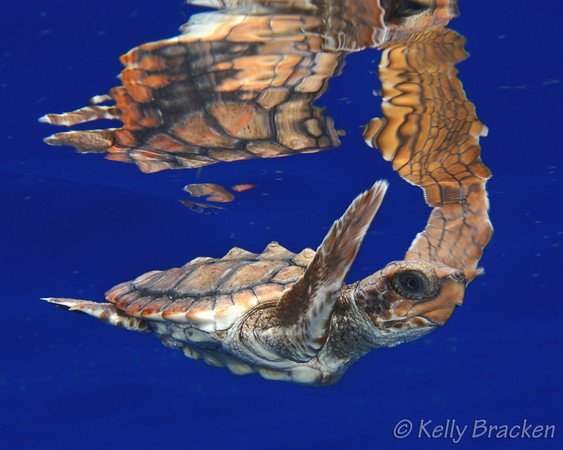
Juvenile loggerhead turtle, right after being released in the open ocean from a rehab center. Photo by Kelly Bracken, while snorkeling. Nikon 17-35mm lens. The turtle was a couple inches from the dome port. These little guys were fast movers and it was hard work to get this shot. Strobes were on low power, and pulled back to avoid overexposing the turtle. Calm early morning conditions helped create a nice reflection.

Baby flying fish, at the surface, spotted from the boat. Photo by Keri Wilk. F32, 1/200th, ISO 1000. d300 + 105mm. The ISO 1000 was by accident, previously set from some cave photography. When Keri saw the flying fish in the water, he quicky grabbed the camera and jumped in.

Baby Mola-mola with reflection. The angle was a little greater than 48 degrees, and there was a little bit of wave action, so you get a mix of reflection and surface in the photo.
Photography tips on shooting reflections underwater
Reflections are best when the surface is calm, clear, and there is little wind - such as early morning
According to physics your angle from the surface must be less than 42 degrees to get a full reflection. For example, If you are right under the subject, you won't get a reflection. Past 42 degrees, as you move away from the subject and towards the surface, you will. Read more about the physics in the comments at the end of the article.
Try to find subjects close to the surface
Don't be afraid to snorkel to find subjects at the surface with reflections
Be careful to control your breathing, bubbles can disturb the surface. Keri Wilk gave me this advice, and he sometimes will overweight himself to make it easier to hold his breathe.
You need to be somewhere where there are subjects on the surface. The indo-pacific region is a great place for this, especially at night when you are on a boat with it's lights on, the lights will often attract lots of marine life to the surface at night.
Further reading
RECOMMENDED ARTICLES


ALSO BY TODD WINNER


SUPPORT THE UNDERWATER PHOTOGRAPHY GUIDE:
The Best Service & Prices on u/w Photo Gear
 Visit Bluewater Photo & Video for all your underwater photography and video gear. Click, or call the team at (310) 633-5052 for expert advice!
The Best Pricing, Service & Expert Advice to Book your Dive Trips
 Bluewater Travel is your full-service scuba travel agency. Let our expert advisers plan and book your next dive vacation. Run by divers, for divers.