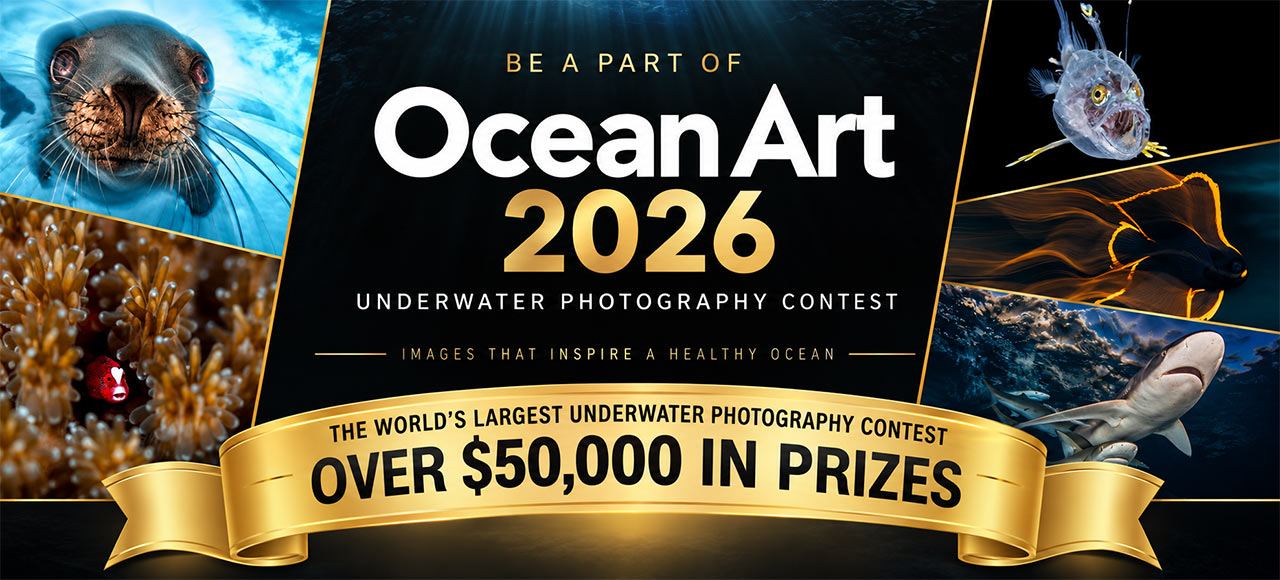
Ocean Art 2026
The Ocean Art Underwater Photo Competition returns with more than
$50,000 in prizes
from some of the world’s top liveaboard, resort, and underwater photography sponsors.
Thank you for considering entry in the 2026 edition of the
Underwater Photography Guide’s Ocean Art Underwater Photo Competition.
We have many categories designed to ensure photographers find the right category
for each of their images, no matter how unique. Ocean Art 2026 features 15 categories,
from Blackwater and Conservation to Nudibranchs, Wide-Angle, Macro, Compact Camera,
Digital Art, and more.
This is a virtual contest. Simply upload underwater photographs taken anywhere,
at any time.
Instructions & Entry Fees
Register, select the number of photographs you would like to enter,
complete payment, and upload your images.
Simple Entry Pricing
Entry fee is $10 USD per photograph.
11 photos for $100
Enter 10 photographs and receive the 11th entry free.
22 photos for $200
Pay for 20 photographs and receive two additional entries free.
$10
USD per photo
Submitting Images
- You will be required to log in.
- Select the number of images you wish to submit.
- Pay the required entry fee.
- Upload your images and complete the requested photo information.
- You may return to your Underwater Photography Guide profile to review uploads, edit photo information, or finish an incomplete submission.
Multiple Categories
A single image may be submitted in multiple categories. Each category submission requires an individual entry fee.
A single photograph may only place in one category.
Questions? Email
contest@uwphotographyguide.com
File Specifications
Please review these requirements before uploading your competition entries.
Image Format
- JPEG/JPG images only
- At least 2,500 pixels on the longest side
- Maximum file size: 5MB
- sRGB color space is recommended
Image Presentation
- Watermarks are not allowed
- Scanned slides are acceptable
- Advanced editing must be disclosed in the photo caption
Finalists
- Original RAW files will be requested
- High-resolution JPEG files will also be requested
- Winning images may be requested for contest coverage in dive media
Watermarked images will be disqualified.
Contest Rules
Ocean Art is committed to conducting the competition ethically,
fairly, and with respect for marine life.
Competition Overview
- UWPG pledges to run this contest ethically and with the utmost integrity.
- Judges will not see image titles or any other references identifying photographers.
- Images submitted with watermarks will be disqualified.
- Photos must be submitted using the online entry form. If you experience difficulties, email
contest@uwphotographyguide.com
- All photographers are eligible, including amateur, semi-professional, and professional photographers.
- There is no timeframe for eligible photographs. Images taken during any year may be submitted.
- Photos resulting from harassment of marine life that could be harmful to the subject may be disqualified at the judges’ discretion.
- All subjects must be alive and in their natural environment. Captive animals will not be considered. Entrapment, or previous entrapment of any kind, is not permitted. Photos documenting conservation efforts in the Underwater Conservation category may be an exception.
- All photographs must normally be taken in a natural water environment such as an ocean or lake. Pools, aquariums, and controlled environments are not permitted except for entries in the Underwater Digital Art and Underwater Fashion categories.
- The photographer must have been in the water when taking the photograph. Pole-camera images are not permitted. Over-under and split shots are accepted. Conservation entries may be an exception when appropriate.
- AI masking, sharpening, and denoise tools are permitted. Generative AI software that produces artifacts or visual elements that did not exist in the original photograph is not permitted.
Photo Rights & Judging
- All images are eligible regardless of past use. However, images that have not previously placed in a major international competition and have not been widely seen in publication may be favored by the judges.
- By submitting images, entrants grant permission to the Underwater Photography Guide to use winning entries for the direct promotion of Underwater Photography Guide photo competitions, including Ocean Art.
- All photo rights remain with the photographer. Images used online for competition promotion will include an Ocean Art Contest watermark and the photographer’s name.
- Ocean Art does not acquire additional commercial ownership rights to submitted photographs.
- Winners and prize awards are expected to be announced in early to mid-January 2027 on the
Underwater Photography Guide homepage and social media channels:
Facebook,
Instagram,
and
X/Twitter. - All judges’ decisions are final.
- Judges include world-renowned underwater photographers Tony Wu, Marty Snyderman, Mark Strickland, and Ipah Uid Lynn.
- Marty Snyderman is an Emmy winner whose work has appeared in major publications including National Geographic. Tony Wu is a renowned underwater photographer and author of Silent Symphony. Mark Strickland is a published author, award-winning underwater photographer, and photo specialist at Bluewater Photo. Ipah Uid Lynn is a Canon Ambassador, Marelux Ambassador, and award-winning underwater photographer.
- The competition is organized by Nirupam Nigam of Bluewater Photo, Bluewater Travel, and the Underwater Photography Guide.
Editing Rules
This is a photography competition, not a Photoshop competition. Photoshop,
Lightroom, and similar post-processing software are accepted tools for processing images,
but they are not substitutes for good photography.
Authenticity is paramount. Editing that enhances the photographer’s original image is
permitted as outlined below. Editing that misrepresents the original scene or capture
will not be accepted.
There are no Photoshop limits in the Underwater Digital Art and Underwater Fashion categories. These categories are designed to allow full creative freedom, and the standard editing restrictions below do not apply.
✓ Allowed
- Global changes including color temperature, brightness, contrast, minor dodge and burn, sharpening, saturation, tonal adjustments, and color balance.
- Masking tools for localized adjustments, including subject and object selection.
- Local adjustments to color temperature, brightness, contrast, noise, sharpening, saturation, tonal balance, and color balance.
- Non-generative AI sharpening, denoise, and masking tools.
- Rotation, flip, and flop.
- Limited removal of backscatter.
- Reasonable cropping, subject to category-specific restrictions.
✕ Not Allowed
- Composite images, blended exposures, HDR, or focus stacking.
- Cutting and pasting sections from other images.
- Adding, cloning, or creating objects such as divers, fish, or artificial flashlight effects.
- Removing scene elements such as divers, fish, bubbles, or ropes.
- Painting or burning the background of an image black.
- Excessive blurring, excessive darkening of the background, or excessive vignetting.
- Generative AI tools that create artifacts or visual elements that did not exist in the original photograph.
Original RAW files straight from the camera, along with a high-resolution JPEG,
will be requested from finalists for auditing. An entry may be disqualified if
an original RAW or original JPEG cannot be provided. Finalists are expected to
be contacted during mid-December 2026 before the second round of judging.
Ocean Art 2026 Categories
Ocean Art categories are loosely defined. Our experienced judging panel will
use professional judgment and common sense when determining winners.
Entries in the three Compact Camera categories must be photographed with a
point-and-shoot camera that does not have interchangeable lenses. Entries in the smartphone category must be photographed with a smartphone.
Wide-Angle
Any photograph showing a wider angle of view than the human eye, including over-under shots and close-focus wide-angle images. Stitched panoramas are not currently permitted.
Macro
Any photograph where the subject is recorded life-size or greater on the camera’s image sensor, generally a 1:1 or greater reproduction ratio. Macro subjects are typically around six inches across or smaller.
Marine Life Behavior
Underwater photographs showing marine life in action, including feeding, cleaning, schooling, yawning, playing, mating, and other natural behaviors.
Marine Life Portrait
A portrait of an underwater animal including fish, sharks, sea lions, octopus, marine birds, and other marine life. Portraits may show the full subject or focus tightly on the face or head.
Cold Water / Temperate Water
Any underwater photograph taken in a cold or temperate environment where water temperatures remain below approximately 15°C / 59°F for much of the year.
Eligible destinations include California, New Zealand, the UK, Northern Europe, the Arctic and Antarctic, Chile, Tasmania, the Black Sea, the Pacific Northwest, and the Northern Atlantic.
The Mediterranean and southern Australia are not included. Tasmania is eligible.
Unsure whether your area qualifies?
Just ask.
Nudibranchs
The main subject should be a nudibranch or other sea slug. We recommend that the nudibranch is prominent within the composition.
Blackwater
Blackwater photographs show pelagic organisms in the water column against a characteristic black background. Most subjects are macro, although larger subjects may also qualify if the image retains the characteristic blackwater appearance.
Both blackwater and bonfire-dive photographs are accepted.
Learn more about blackwater photography.
Black & White
Photographs presented in black, white, and shades of gray. Images do not need to have originally been captured in black and white, but the standard editing rules still apply.
Underwater Conservation
Photographs that inspire protection and care for oceans, lakes, rivers, or other natural aquatic environments. Images may show environmental tragedy or conservation efforts. The image does not have to be photographed underwater but must relate directly to underwater conservation.
Compact Wide-Angle
Wide-angle photographs taken with a compact camera. Wide-angle subjects are generally larger than approximately six inches.
Compact Macro
Macro and supermacro photographs captured with a compact camera. Macro subjects are generally smaller than approximately six inches.
Compact Behavior
Compact-camera photographs showing marine life in action, including feeding, cleaning, schooling, yawning, playing, mating, and other natural behaviors.
Underwater Digital Art
Images may be captured in any underwater environment and digitally manipulated in any way desired by the artist. Subjects may range from abstract concepts to people or marine life. Commercial photographs are allowed, and there are no post-processing restrictions.
Underwater Fashion
Images emphasizing people, including divers, freedivers, and models. Photographs may be created in natural or controlled underwater environments, including pools and tanks. Commercial photography is allowed, and there are no post-processing restrictions.
Smartphone
Any underwater photograph may be submitted here, whether wide angle or macro, but it must have been taken using a smartphone
How Prizes Are Awarded
Winners will be asked to rank prizes after judging is completed, but before the contest results are publicly announced. Each winner will receive the highest-ranked prize still available from their preference list.
Best of Show will receive additional preference in the prize selection process. First-place winners select before second-place winners, second-place winners before third-place winners, and so on.
Winners may receive only one prize. Ranked winners will be awarded prizes until the available prize pool is exhausted. First-place category winners are guaranteed a prize. Prize availability is subject to change based on sponsor decisions.
The exact category point-ranking system used to determine prize selection order will be determined by the judges based on the number of entries and competitiveness of each category.
Winners are expected to learn their final placement and awarded prize when Ocean Art 2026 results are announced in early to mid-January 2027.
Ready to Enter Ocean Art 2026?
Submit your best underwater images and compete for more than $60,000
in prizes from leading underwater photography, dive travel, and resort sponsors.