Honorable Mention Underwater Conservation
Thomas Pavy
“Tamataroa“
The Story:
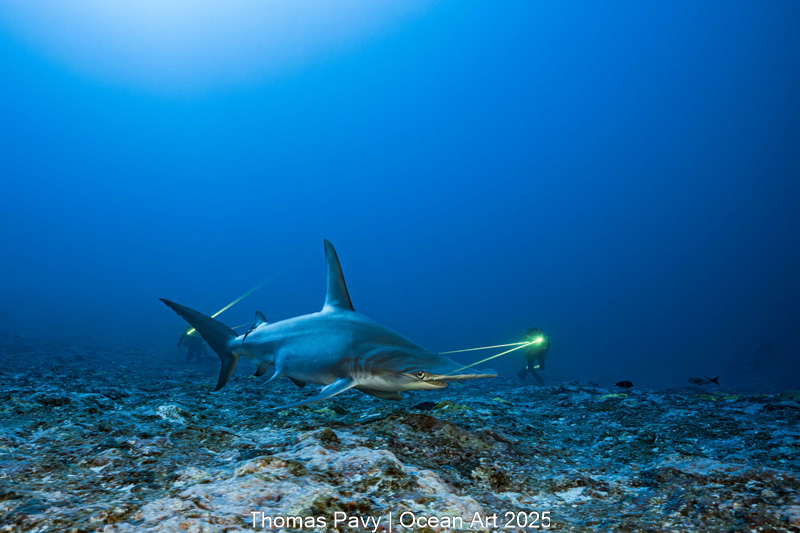
This photography was shot at a depth of 55m in Tiputa Pass (Rangiroa Atoll, French Polynesia) during a Sphyrna mokarran (Great Hammer Head Shark) population survey.
Antonin Guilbert and Nicolas Mollon, the two scientists working on the photos, are utilising a video photogrammetry system that consists of a plate-mounted video camera that has been laser-calibrated. By identifying individuals (photo identification), describing the sex ratio, and quantifying their size (laser calibration), this method enables the scientists to characterise Sphyrna mokarran populations. Scientists must employ sophisticated diving techniques like trimix gaz and close circuit rebreather in order to carry out the program.
Because currents and divers’ navigation can be challenging and dangerous in a pass where currents can reach 6 or 7 knots, such dives demand a great deal of experience. Furthermore, only video frames with two lasers aimed at the shark’s side and a perfect perpendicular profile of the animal can provide pertinent information for shark identification.
Over the last 6 years, the methodology has been applied by different teams (Mokarran Protection Society and Andromède Océanologie) and revealed over 180 individuals.
The Great Hammer Head Shark is widely revered in the local culture, and sharks have been protected in French Polynesia for over a decade. The Great Hammer Head shark is locally called Tamataroa.
Location:
Tiputa Pass, Rangiroa Atoll, French Polynesia,
Equipment Used:
- Camera – Sony A7II camera
- Housing – Seacam
- Strobe/light – Seacam Strobes
- Lens: 20mm Tokina lens
Camera Settings:
- ISO 800
- F/10
- Shutter speed 1/100s