Ocean Art 2025 Stories behind the Image – Jeff Milisen
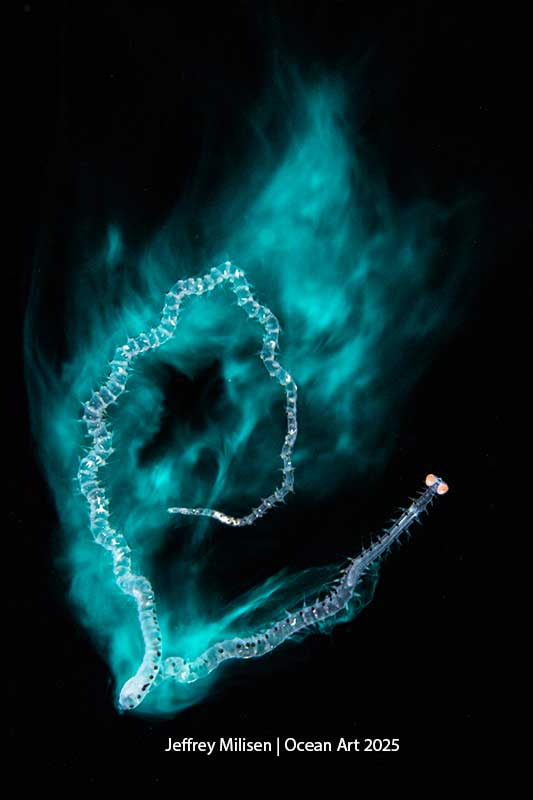
Jeff Milisen received an Honorable Mention in the Marine Life Behavior for his “Alciopid in Ink” Photo.
Biography
What does placing in Ocean Art mean to me?
Before 2014, I was a nobody underwater photographer who yearned to see the world. That year, I won the Ocean Art contest’s Macro category, the prize for which was a week of diving at Kosrae’s Nautilus Resort. This contest not only encouraged me to put my work out there more, but it also led to my first international dive trip, an addiction that I maintain to this day. I view Ocean Art 2014 as a piece of the turning point that led to who I have become.
Today, my work is a combination of art and science to explore and advocate for the natural world that we all rely on. Photography drives science communication and complements my own path of open-ocean discovery. The hope is that the eye-candy reaches and encourages people of all walks of life to learn about the open ocean or join me on a drifting exploration and experience it for themselves. Each part is critical to the others. There are scant few avenues where you can reach a larger audience than a competition as prestigious as the Underwater Photography Guide’s Ocean Art contest, so this honorable mention is a big win for the ocean! After all, what good is a discovery if it is kept to yourself?
Story of the Shot
I’ve been guiding, studying, and photographing the life we see on blackwater dives out of Kona, Hawaii, for well over a decade. Until my book came out in 2020, the challenge was always that most of these creatures aren’t in any of the usual field guides, so you can’t just flip through the pages to find something that looks similar and read about it. Every single dive brings us face-to-face with something we can’t readily identify. What’s more, we are painfully aware that what comes in to check us out is just a slice of the life that lives just beyond our lights. Of the 47-ish species of squids found in Hawaiian epipelagic water, we can see 23 of them. So when we saw little green/blue ink blobs drifting through the divers, we used to assume they were some strange squid that got scared, inked, and jetted off before we could see it. That is, until we looked closer and noticed Alciopid worms hanging around the ink.
I started noticing that a worm was usually associated with the cloud. I was puzzled. Were they eating squid ink? As the months drew on, I started noticing the behavior more frequently. One night, I saw the ink streaming from the parapodia of the worms themselves, and it dawned on me-the worms were producing ink! To make sure, I poked a worm and, sure enough, it produced the green-blue cloud. Soon after, I did a dive where drops of ink drifted through the divers, each with a resting worm curled up in the drop. These worms were using the ink in very different ways from squids.
These observations of Alciopid worms are still ongoing. I’m not sure where these observations may lead, and I may never get to the bottom of this behavior. For now, it is a beautiful behavior that, to my knowledge, wasn’t previously recognized.