Precision 5" Dome for Tokina 10-17mm Lens

Michael Zeigler
A look at this new 5" dome port for the Tokina 10-17mm lens and Ikelite dSLR housings.

Precision 5" Dome Port

Designed specifically for the Tokina 10-17mm lens & Ikelite dSLR housings

By Michael Zeigler

 
SHARE THIS STORY

Looking for a dome port for your Tokina 10-17mm fisheye lens?  I was too, and that's when I found out about the Precision 5" Dome.  What's great about this dome port is that it's designed specifically for the Tokina 10-17mm lens, and my Ikelite housing.

I find that the Precision Dome attaches easily and securely to my housing via the four port-locks, and its small size makes packing easy.  But more importantly, it allows me to take some great underwater photos.


The Precision 5" Dome with the Deluxe Dome Shade attached.  And yes, if you look closely, you can see my bald "dome" in the dome.


The Precision 5" Dome on my Ikelite D90 housing.


Side view


The Precision Dome details

The Precision 5" Dome is manufactured based on calculations using the nodal point of the Tokina 10-17mm fisheye lens and the Ikelite dSLR housing. The calculations define the distance between the lens nodal point and the dome, resulting in sharper edge-to-edge focus when compared to other generic dome ports. A wider angle of view is achieved from the use of a half-sphere dome.

The small size allows you to get extremely close to your subjects, which is great for close-focus wide-angle photography.

You will need the Ikelite 5510.11 or 5510.10 super-wide-angle port body with the dome. Another option is to use a 1.4 teleconverter (Kenko Teleplus Pro 1.4x) in conjunction with the Ikelite 5510.16 standard zoom port body.


Benefits of the Precision 5” Dome

  • Ultra sharp with the Tokina 10-17mm lens 

  • Wider angle-of-view

  • Better edge-to-edge image sharpness than other generic domes

  • Absolutely no vignetting with the shade

  • Small size allows you to get closer to your subjects - great for CFWA shots!

  • Very small and light - makes packing and traveling with your equipment so much easier

  • Acrylic material means light scratches will generally not appear in photos. Deeper scratches can be "meshed out" with an acrylic mesh kit.

  • All domes are vacuum leak tested

  • Includes Port Lock (for the Ikelite port body), Deluxe Dome Shade, Dust Cover, and Dome port Cover

This Precision Dome is available through our sponsor, Bluewater Photo.  Please call them at (310) 633-5052 or visit their website if you have any questions.


Underwater photos taken using a Nikon D90 in an Ikelite housing, Tokina 10-17mm fisheye lens, and the Precision 5" Dome


Wreck of a Piper Warrior off the coast of Catalina Island, CA.  F3.5, 1/8th, ISO 800 at 10mm.


Sheepcrab at Catalina Island, CA.  F5.6, 1/80th, ISO 200 at 17mm.


Garibaldi and kelp at Blue Cavern - Catalina Island, CA.  F9, 1/25th, ISO 200 at 10mm.


About the Author


Michael Zeigler is editor-at-large for the Underwater Photography Guide, trip leader and instructor for Bluewater Photo, and is an AAUS Scientific Diver. Michael's underwater photography and blog can be seen at SeaInFocus.com.

Join Michael as he leads an amazing underwater photography workshop at the famous Wakatobi Dive Resort 11/21/13 - 12/2/13!


Further Reading


Special thanks to the captain and crew of Sundiver Charters in Long Beach, CA for the great dives and service.  -Ed.


Support the Underwater Photography Guide

Please support the Underwater Photography Guide by purchasing your underwater photography gear through our sister site, Bluewater Photo & Video. Click, or call them at (310) 633-5052 for expert advice!


Nauticam Viewfinder

Todd Winner
I've always been jealous of expensive viewfinders. Now I finally got to try one...

Nauticam 180 Viewfinder

by Todd Winner

 
SHARE THIS STORY

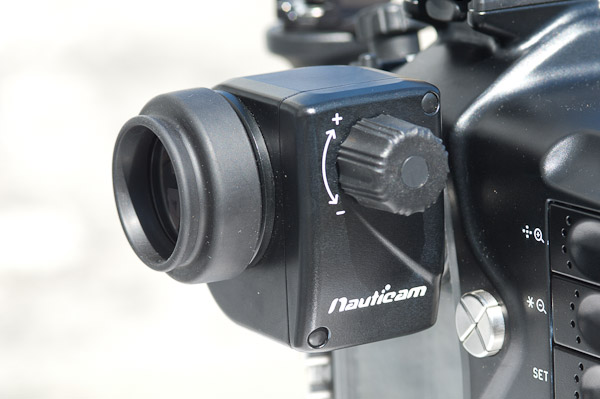
I have to admit over the past few years I have become increasingly jealous every time somebody showed up on a boat with one of those big expensive viewfinders on their housing. So when Dave Hinkel offered me an opportunity to try out the Nauticam 180 Viewfinder on the Nauticam Canon 7D housing, I jumped at the chance.


Nauticam viewfinder


First Impression of the Nauticam viewfinder:

It's big and it's bright! The Nauticam 180 viewfinder gives you a much larger image of the camera's viewfinder giving you a greater advantage for critical focus and composition. The 180 viewfinder features a diopter adjustment knob that is large and easy to adjust even while wearing gloves underwater.

It does require a little practice to get used to the 180 viewfinder. I found that underwater, I had to be more precise and look directly inline thru the 180 viewfinder as oppose to still being able to focus thru the standard viewfinder at slight angles.

The LCD screen is still 100% visible even with the 180 viewfinder attached so you are still able to review your images and shoot video. Although if I was specifically doing video dives, I would leave it off just to give myself a more unrestrictive view of the LCD screen.


Installing the viewfinder:

Installing the 180 viewfinder couldn't be any simpler. The standard Nauticam viewfinder is easily removed by taking off the internal o-ring and sliding it out of the back of the housing. The 180 viewfinder has 2 pins to keep it from spinning and is held in place with an internal o-ring. Nauticam makes specially designed adapters so the viewfinder can also be used on Aquatica, Ikelite, Nexus and Sea & Sea Housings.

Now that I have had the opportunity to try one out, I'm hooked. The enhance viewfinders are an expensive accessory from any of the manufacterers, but if you can afford it, in my opinion it is worth the investment.

nauticam viewfinder


Further Reading

More Underwater Photography Equipment Reviews


Where to Purchase

Our sister site Bluewater Photo carries the Nauticam 180 viewfinder, thank you for helping to support the Underwater Photography Guide.


Sea & Sea Glass & Acrylic Dome Port tests

Scott Gietler
Sea & Sea fisheye, compact, acrylic and glass dome port review

Sea & Sea fisheye, compact, acrylic and glass dome port review

By Scott Gietler


SHARE THIS STORY

In this review I tested 3 Sea and Sea dome ports with my Nikon D300 and Tokina 10-17mm lens in the swimming pool, checking sharpness, color and contrast.


Sea & Sea Compact dome port


The S&S compact dome port is a light-weight, 6 inch acrylic dome port. Total width is 6.5 inches including the outer plastic. 1lb 9oz with the cover and 20mm extension ring. $500 in the USA. The SX extension ring (20mm) is an additional $190.


Sea & Sea glass dome port


The S&S glass dome port is a compact 6 1/2 inch dome port made by Athena for Sea & Sea. 2lb 12oz with the cover and 20mm extension ring. $1250 in the USA. 


Sea & Sea Fisheye dome port


The S&S fisheye dome port is a 8 inch acrylic dome port. Total width is 9.5 inches including the outer plastic. 2lb 9.7oz with the cover. $650 in the USA.


Dome port test methodology


I took hundreds of test shots, at focal lengths of 10mm, 14mm, and 17mm. I took shots at distances of 2ft and 4ft away. I also compared center areas, side areas, and corners of the photos. I took photos at apertures F5.6, F8, F11. I also had two experienced photographers independently compare 100% crops of the test photos.


Glass and Acrylic dome port test results 

  • No difference between glass and compact dome ports
  • No difference between dome ports in center sharpness
  • All dome ports sharp in the center
  • All dome ports sharpest in the corners at F11, and usually fairly sharp at F8, and not too bad at F5.6
  • Large fisheye dome port (acrylic) was best of them all, but only by a small amount in the corners, if you look at 100% crops.


Dome port test conclusions 

  • Compact dome port (acrylic) is best for close-focus wide angle (CFWA) shots, and for travel, and easiest on the pocketbook.
  • Fisheye dome port is slightly better in the corners at F5.6 and F8.
  • No need to spend the extra money on the glass dome port.
  • When using the Tokina 10-17mm fisheye lens, the fisheye dome port does not need the 20mm extension ring, but may benefit from it? (This will be my next test). Rotating the aperture dial is more difficult without the ring on.
  • The compact dome port definitely benefits from the 20mm extension ring.
  • The fisheye dome port will give better results for over and under shots.
  • Glass ports are heavier, more resistant to scratching, and shed water easier that acrylic ports. It's possible that other well-made large glass dome ports have optical advantages over acrylic ports (e.g. - Subal or Seacam ports), but I didn't find any with this particular port.

Disclaimer - these test results may not apply to other manufacturers of dome ports, or in the conditions you shoot in, you should always do your own port tests. Dome ports can vary in quality. 


Further Reading


Dome port optics and the virtual image

CFWA - shooting close focus wide angle underwater

Best lenses for underwater photography

Fisheye lenses versus wide angle lenses

Sea & Sea MDX-D300 underwater housing review


Syndicate content